
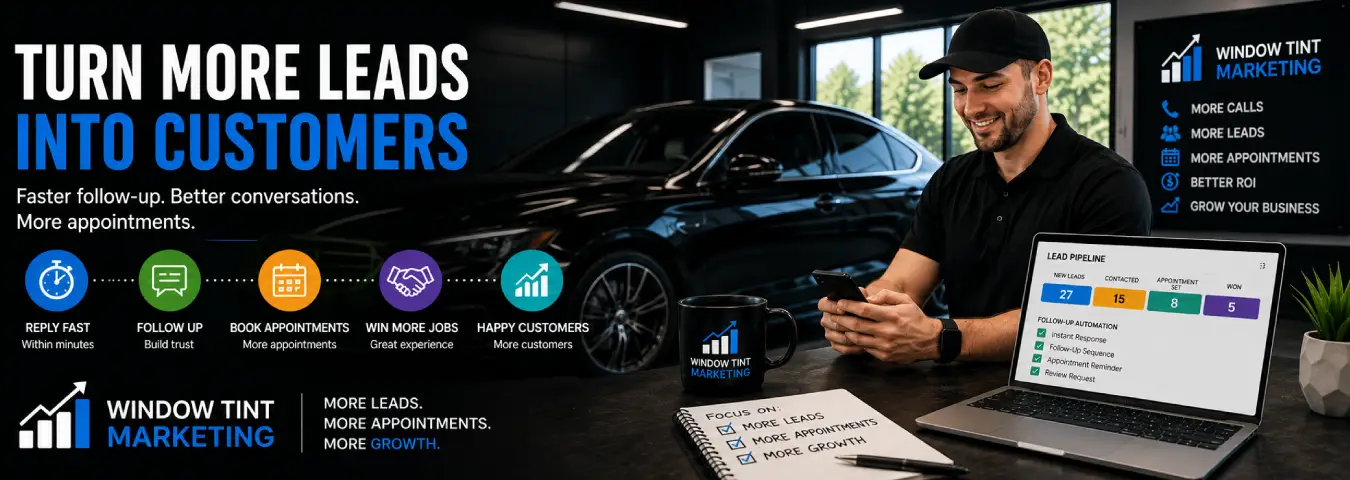
Getting more window tint leads is only half the job. The other half is turning those inquiries into booked appointments and paying customers. A shop can spend more on Google Ads, SEO, social media, or referrals and still struggle to grow if new leads sit unanswered, receive one follow-up, or disappear between the first call and the appointment.
The solution is a repeatable lead follow-up process. That process should help your team respond quickly, collect the information needed to quote accurately, make booking easy, follow up consistently, and track what happens after each inquiry.
This guide explains how window tint shops can build that system without turning customer communication into robotic spam.
Why Window Tint Leads Get Lost
Window tint customers often contact multiple shops while comparing price, film options, availability, warranty terms, and trust. A lead can go cold simply because another shop answered sooner or made the next step easier.
Common sources of lead leakage include unanswered calls, web forms that are checked too late, messages spread across multiple inboxes, incomplete contact information, inconsistent quoting, no follow-up after the first attempt, and no clear process for moving a prospect from inquiry to appointment.
The first improvement, therefore, is not necessarily generating more leads. It is creating one reliable path for handling every lead you already receive.
Map the Lead-to-Customer Journey
Before adding automation, define the stages a real prospect moves through. A simple window tint sales pipeline might look like this:
- New lead: a person calls, submits a form, sends a message, or requests a quote.
- Contacted: your team has responded or attempted contact.
- Qualified: you have enough information to determine whether the requested service is a fit.
- Quoted: the prospect has received pricing or a clear next step for receiving it.
- Appointment scheduled: a date and time have been agreed upon.
- Completed: the customer has received the service.
- Lost or unresponsive: the prospect did not book, chose another provider, or stopped responding.
These stages create accountability. Instead of seeing a database full of names, your team can see which leads need attention and where prospects are dropping out.
Respond to New Leads as Quickly as Your Operation Allows
A new inquiry is easiest to engage while the customer is still thinking about tinting their vehicle. Build a process that alerts the right person immediately and makes responding a priority during business hours.
That does not mean promising an unrealistic response time. Your target should fit your staffing and opening hours. What matters is having a defined standard rather than leaving response speed to chance.
For example, a web form can create a CRM record, notify the assigned employee, and trigger an immediate confirmation message telling the prospect that the request was received. The personal sales response can then follow as soon as a team member is available.
Centralize Leads in a CRM or Lead Management System
If calls are written on paper, website leads remain in email, and social inquiries live in separate apps, follow-up becomes difficult to manage. A central system gives each prospect a record containing contact details, source, vehicle information, requested service, conversation history, appointment status, and outcome.
Your CRM does not need to be complicated. For a local tint shop, the important capabilities are visibility and consistency. Anyone handling the lead should be able to understand what has already happened and what needs to happen next.
Capture the Information Needed to Move the Sale Forward
Ask only for information that helps you qualify the request or prepare the next step. Depending on your services, that might include the customer's name, phone number, email address, vehicle year, make and model, requested windows or coverage, preferred film type, location, and desired appointment timing.
Avoid making the initial form unnecessarily long. If a detail can be collected naturally during the conversation, requiring it before the prospect can contact you may create friction.
Use an Immediate Confirmation Without Pretending It Is a Human Reply
Automation is useful for acknowledging a new inquiry. A simple confirmation can tell the prospect that the shop received the request, state the business hours or expected next step, and make it easy to provide missing information.
Keep automated communication transparent. Do not make a bot-generated message sound as though a specific employee personally wrote it when that is not true.
Also make sure your email and text follow-up practices comply with the laws and consent requirements that apply to your business and customers. Automation does not remove those responsibilities.
Qualify the Lead Before Chasing the Sale
Not every inquiry has equal value. Qualification helps your team spend time on genuine opportunities and give each prospect an accurate recommendation.
Useful qualification questions can include:
- What vehicle do you need tinted?
- Which windows or areas do you want tinted?
- Are you interested in a particular film or performance level?
- What outcome matters most: heat reduction, appearance, glare, privacy, UV protection, or another goal?
- When would you like the work completed?
- Are there any existing tint or film conditions the shop needs to know about?
Qualification should feel like helping the customer choose the right service, not interrogating them.
Make the Quote Easy to Understand
A quote should help the prospect understand what they are buying. If you offer multiple film options, explain the meaningful differences instead of sending a list of unexplained prices.
Where applicable, clarify what the quoted price covers, which film or service level it refers to, warranty terms you can substantiate, expected installation time, and how to reserve an appointment.
Be careful with automated quotes when pricing depends on vehicle configuration or existing film. Automation can collect information and prepare the conversation, but a human should review situations where the system cannot price accurately.
Give Every Qualified Lead a Clear Booking Step
Once the customer is ready, remove unnecessary friction. Do not make someone who has already agreed to proceed start another complicated process to schedule.
Your booking step might be handled by an employee, a scheduling link, or an integrated booking system. Whichever method you use, confirm the date, time, location, service, and any preparation instructions the customer genuinely needs.
If deposits are part of your normal policy, explain the requirement clearly before the customer completes the booking.
Build a Follow-Up Sequence for Leads Who Do Not Book Immediately
Many legitimate prospects will not book during the first conversation. They may be at work, comparing options, waiting for payday, checking their schedule, or simply distracted.
Create a short follow-up sequence that gives those prospects reasonable opportunities to continue the conversation. The exact timing should reflect your sales cycle, communication channel, consent, and customer expectations.
A practical sequence can combine:
- an initial response or acknowledgment
- a personal call or message from the shop
- a follow-up that answers common questions or restates the recommended option
- a booking reminder for interested prospects
- a final check-in before marking the lead unresponsive
Each message should have a purpose. Repeatedly sending “Are you still interested?” adds little value. A better follow-up might clarify an option, answer a likely objection, offer available appointment times, or ask one simple question that moves the decision forward.
Use Automation to Support Staff, Not Replace Judgment
Good automation handles repetitive administrative work while keeping people involved where judgment matters.
Useful automations for a window tint shop can include creating a lead record after a form submission, assigning the lead to an employee, sending an internal notification, acknowledging the inquiry, scheduling follow-up tasks, moving a lead after an appointment is booked, sending legitimate appointment reminders, and flagging leads that have not received a response.
Human attention remains important for unusual vehicles, complex quotes, complaints, detailed film questions, negotiation, and situations where the prospect's intent is unclear.
Handle Phone Leads as Carefully as Form Leads
Phone calls can be easy to lose because a busy installer may answer while working or a caller may reach voicemail. Create a process for missed calls and for recording the outcome of answered calls.
When appropriate and lawful, call tracking can help connect calls with their marketing sources. The important operational step is making sure a missed or qualified call becomes a trackable lead rather than disappearing from the sales process.
If someone leaves a voicemail, assign the callback. If someone receives a quote but does not book, record that status. If the customer books, update the pipeline so staff do not continue sending sales follow-ups unnecessarily.
Connect Marketing Data With Actual Customers
A lead count tells you how many inquiries marketing produced. It does not tell you how many became customers.
Track outcomes beyond the initial form or call whenever your systems allow it. Useful metrics include qualified leads, quotes, appointments booked, completed jobs, lead-to-booking rate, cost per qualified lead, cost per booked customer, and revenue associated with marketing sources.
For businesses advertising with Google Ads, Google's current enhanced conversions for leads workflow can use first-party lead information and imported offline outcomes to improve measurement of leads that later become customers. Google recommends using meaningful stages such as “Qualified lead” or “Converted lead” when setting up these conversion goals. The platform also supports connecting CRM or other first-party data through Google Ads Data Manager.
Official guidance: Google Ads enhanced conversions for leads and Google Ads Data Manager for lead conversions.
Measure the Conversion Rate at Each Stage
Once your pipeline is consistent, you can diagnose where revenue is being lost.
For example, if many leads never become qualified, investigate lead quality and the initial response process. If qualified leads receive quotes but rarely schedule, review pricing communication, trust signals, sales conversations, and booking friction. If appointments are scheduled but completion is weak, investigate reminders, deposits, scheduling, and no-show patterns.
Do not assume every problem is a marketing problem. A campaign can generate appropriate prospects while a weak follow-up process prevents those prospects from becoming customers.
Review Lost Leads for Patterns
A simple lost-reason field can make your CRM more useful. When practical, record why a lead did not convert using a small, consistent set of reasons such as no response, outside service area, service not offered, price objection, timing, chose another provider, or invalid inquiry.
Over time, those patterns can inform advertising, website content, pricing communication, staffing, and follow-up strategy.
Avoid forcing employees to guess. If the reason is unknown, record it as unknown rather than creating false certainty.
Create a Daily Lead Follow-Up Routine
Automation works best when paired with a simple human routine. At the beginning and end of each business day, the responsible person can review new leads, overdue follow-ups, quotes awaiting decisions, upcoming appointments, missed calls, and leads with incomplete information.
This routine catches exceptions that automation cannot resolve and prevents prospects from remaining forgotten in the pipeline.
A Practical Window Tint Lead Conversion Workflow
- A prospect calls, messages, or submits a quote request.
- The lead is recorded in one central system.
- The appropriate employee receives an alert.
- The prospect receives a transparent acknowledgment where appropriate.
- A team member contacts and qualifies the lead.
- The shop recommends the appropriate service and provides a clear quote or quoting process.
- The prospect receives a straightforward booking option.
- If the prospect does not book, scheduled follow-up tasks or messages continue for a reasonable period.
- Once booked, sales follow-up stops and appointment communication begins.
- After the service, the lead is marked completed and the original marketing source is retained where possible.
- Lost opportunities are categorized accurately enough to identify recurring problems.
Common Lead Follow-Up Mistakes
- Buying more leads before fixing response problems: additional advertising can simply create more leakage.
- Keeping leads in multiple disconnected inboxes: this makes ownership and follow-up difficult to see.
- Sending one quote and giving up: interested prospects are not always ready to book immediately.
- Automating every conversation: complex questions and high-intent prospects often need human judgment.
- Following up after the customer already booked: disconnected systems create a poor experience.
- Measuring only raw lead volume: qualified leads, appointments, and completed jobs provide a better view of business value.
- Using automation without appropriate consent and compliance processes: marketing technology does not override communication laws or platform policies.
Frequently Asked Questions
How can a window tint shop convert more leads?
Start by improving the process between inquiry and appointment: centralize leads, respond consistently, qualify prospects, explain quotes clearly, make booking easy, follow up with interested non-buyers, and track which inquiries become completed jobs.
Should window tint shops automate lead follow-up?
Automation can be useful for acknowledgments, staff notifications, task creation, reminders, pipeline updates, and other repetitive work. Keep employees involved when the customer needs advice, a complex quote, problem resolution, or a nuanced sales conversation.
How many times should a tint shop follow up?
There is no universal number that fits every shop or lead. Use a reasonable sequence based on the customer's interest, your sales cycle, the communication channel, and applicable consent requirements. Stop when the prospect opts out, clearly declines, or no longer fits the opportunity.
What should a window tint CRM track?
At minimum, track contact details, lead source, requested service, relevant vehicle information, pipeline stage, conversation history, quote status, appointment status, next follow-up, and final outcome. Keep the system simple enough that staff will actually maintain it.
Turn Lead Follow-Up Into a Growth System
The most valuable lead is not necessarily the cheapest one. It is the qualified prospect your shop can turn into a profitable customer.
Instead of treating each inquiry as an isolated call or form submission, build a repeatable system around it. Centralize the lead, respond consistently, give the customer a useful next step, follow up without becoming intrusive, and record the outcome. Then use that data to improve both marketing and sales.
For a window tint shop, even a strong advertising strategy becomes more valuable when fewer legitimate opportunities disappear between the first inquiry and the appointment calendar.
Ready to grow your business?
Book a free strategy call and see what's possible.