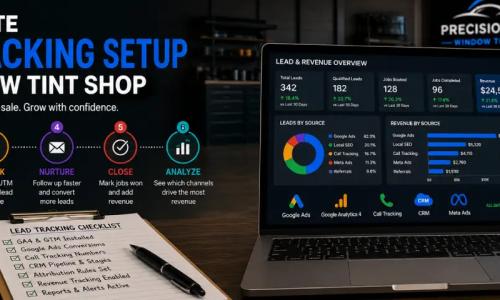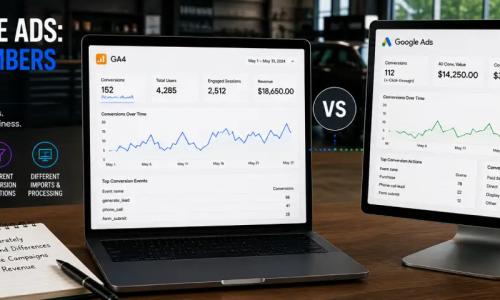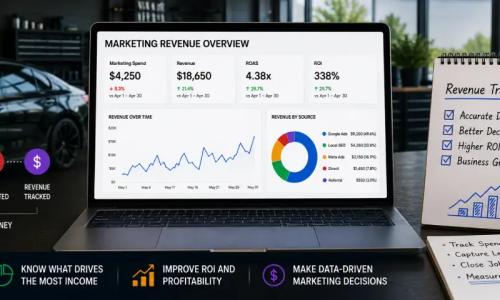

Marketing reports can show clicks, calls, form submissions, and bookings, but those numbers do not automatically tell a window tint business whether its marketing is profitable. To measure marketing ROI, you need to connect marketing cost with the business value created after the lead arrives.
That means moving beyond traffic and cost per lead. A useful ROI measurement system follows the customer journey from marketing source to lead, from lead to booked appointment, and from booked appointment to completed revenue or profit.
What Marketing ROI Means for a Window Tint Business
At its simplest, return on investment compares the return produced by an investment with the cost of that investment. For marketing, a practical profit-based formula is:
Marketing ROI = (Profit attributable to marketing − Marketing cost) ÷ Marketing cost × 100
Return on ad spend, or ROAS, is related but different. ROAS normally compares conversion or revenue value with advertising cost:
ROAS = Revenue attributable to ads ÷ Ad spend
Google Ads uses a similar relationship in its conversion value per cost metric, calculated as conversion value divided by cost. Google describes this metric as an estimate of return on investment within the advertising platform.
The distinction matters. Revenue-based ROAS tells you how much tracked revenue was produced per advertising dollar, while a broader marketing ROI calculation can account for the costs and margins required to produce that revenue.
Start With the Business Outcomes You Actually Care About
A tint shop should not measure marketing success only by the easiest numbers to collect. Website traffic and ad clicks are useful diagnostic metrics, but they are several steps away from revenue.
A practical measurement hierarchy looks like this:
| Stage | Example metric | What it tells you |
|---|---|---|
| Attention | Clicks, sessions | How much traffic marketing generated |
| Lead | Quote forms, tracked calls | How many prospects contacted the shop |
| Qualified lead | Qualified inquiries | How many leads fit your sales criteria |
| Booking | Confirmed appointments | How many prospects scheduled service |
| Customer | Completed jobs | How many opportunities produced business |
| Financial result | Revenue, gross profit | What the marketing ultimately returned |
The farther down this funnel you can measure accurately, the more useful your ROI analysis becomes.
Calculate Cost per Lead, Qualified Lead, and Booking
Before calculating full ROI, build a clear view of acquisition costs at each stage.
Cost per lead = Marketing spend ÷ Number of leads
Cost per qualified lead = Marketing spend ÷ Number of qualified leads
Cost per booking = Marketing spend ÷ Number of booked appointments
Customer acquisition cost = Relevant acquisition cost ÷ Number of acquired customers
These metrics reveal where performance changes. A campaign can have an attractive cost per lead but a poor cost per booking if many inquiries are irrelevant or never schedule.
An illustrative example
Suppose a tint shop spends $2,000 on a campaign and generates 40 leads. The cost per lead is $50. If 20 of those leads become qualified and 10 schedule appointments, the same campaign has a $100 cost per qualified lead and a $200 cost per booking.
These figures are illustrative, not industry benchmarks. Your acceptable acquisition costs depend on your pricing, service mix, margins, close rate, and repeat business.
Assign Value to the Conversion That Matters
Google Ads supports conversion values so advertisers can measure more than the number of conversions. Google states that conversion values can help measure the business impact of campaigns and support value-based bidding strategies.
For a window tint business, the strongest conversion value is usually based on a meaningful downstream outcome rather than an arbitrary amount assigned to every website click.
If the actual job value can be passed back after a sale, use that information when your systems support it. If you only know the lead or booking at first, you can still measure those stages separately and later connect them with CRM outcomes.
Track Leads by Marketing Source
ROI measurement depends on attribution: you need a reasonable way to connect leads and customers with the marketing interactions that contributed to them.
Google Analytics provides advertising and attribution reports that can show conversion and key-event performance by channel and help analyze the paths users take before important actions. Attribution models determine how credit is assigned to touchpoints along those paths.
For your own reporting, keep source information consistent across the systems involved. Depending on your setup, useful fields may include:
- source and medium;
- campaign;
- landing page;
- Google Ads campaign or click identifiers where available;
- lead type, such as form or phone call;
- booking status; and
- completed revenue or profit.
The goal is to preserve enough information to follow a lead from acquisition through the sales process.
Connect GA4 and Google Ads to Important Actions
In Google Analytics 4, actions that are especially important to the business are called key events. Any collected event can be marked as a key event when it represents an important outcome.
Google Ads conversions can also be created from Analytics key events. Google says that once a Google Ads conversion is based on a GA4 key event, conversion data can be shared across Google Ads and Analytics, helping advertisers measure campaign performance and use conversions for bidding.
For a tint shop, important events might include a successful quote request or confirmed online booking. Supporting events such as phone-link clicks or booking starts can remain useful without being treated as equivalent to a completed lead or appointment.
Connect Offline Outcomes Back to Marketing
Many tint customers do not complete the entire journey online. A prospect might submit a quote request, speak with your team, schedule by phone, and pay after the vehicle is serviced. Website analytics alone cannot automatically know all of those outcomes.
This is where CRM and offline conversion measurement become important. Google Ads' enhanced conversions for leads can use first-party lead data to improve the connection between online advertising interactions and later offline outcomes. Google currently recommends Data Manager for enhanced-conversions-for-leads workflows and describes traditional offline conversion import as a legacy approach.
As of 2026, Google has also unified enhanced conversions for web and leads under a single account-level setting. For businesses implementing current offline measurement workflows, it is worth reviewing Google's latest Data Manager requirements rather than relying on older setup instructions.
The business benefit is straightforward: instead of optimizing only for form submissions, you can work toward understanding which marketing efforts produce qualified leads, bookings, and customers.
Include the Right Costs in Your ROI Calculation
The word “marketing cost” can mean different things depending on what you are trying to evaluate. Be consistent about what is included.
For a campaign-level ROAS calculation, you may compare tracked revenue directly with media spend. For a broader marketing ROI analysis, relevant costs might include advertising spend, agency or contractor fees, software used specifically for acquisition, creative production, and other directly attributable marketing costs.
If you calculate ROI using profit rather than revenue, account for the costs required to deliver the service consistently. The objective is not to create the most complicated spreadsheet possible; it is to make sure the numerator and denominator represent the business question you are asking.
Revenue Is Not the Same as Profit
A campaign can generate substantial revenue without generating an equally strong profit return. Different tint services can have different material requirements, labor demands, pricing, and margins.
If two campaigns each generate the same amount of revenue but one produces a more profitable mix of jobs, revenue-only reporting may make them look identical. Profit-based analysis can reveal the difference.
Start with revenue if that is the reliable data you have. As your tracking improves, add gross-profit or contribution-margin information when it can be measured consistently.
Measure Close Rate by Marketing Source
Lead quality becomes clearer when you measure what happens after the inquiry.
Lead-to-booking rate = Bookings ÷ Leads × 100
Lead-to-customer rate = Customers ÷ Leads × 100
These rates help explain why two channels with similar lead costs can produce different financial results. One source may generate inexpensive inquiries that rarely book, while another produces fewer but more qualified prospects.
Review the entire funnel before increasing or cutting budget based on cost per lead alone.
Build a Simple Marketing ROI Scorecard
A weekly or monthly scorecard can keep the analysis focused. For each major channel or campaign, record:
| Metric | Purpose |
|---|---|
| Marketing spend | Shows acquisition investment |
| Leads | Measures initial inquiries |
| Qualified leads | Measures lead quality |
| Bookings | Measures scheduled opportunities |
| Completed customers | Measures closed business |
| Revenue | Measures sales value |
| Gross profit or contribution value | Supports profitability analysis |
| Cost per lead | Measures lead acquisition efficiency |
| Cost per booking | Measures appointment acquisition efficiency |
| ROAS | Compares attributable revenue with ad spend |
| Marketing ROI | Compares attributable return with marketing investment |
Use the same definitions from period to period. Changing what counts as a lead, booking, cost, or customer can make trend comparisons misleading.
Be Careful With Attribution
Customers can interact with several marketing touchpoints before converting. Google Analytics' attribution reports are designed to help analyze those paths and compare how credit changes under different attribution approaches.
That means an ROI report should not always be interpreted as a perfect statement of causality. Attribution is a measurement framework for assigning credit. Use it consistently, understand its limitations, and compare it with your CRM and sales data.
This is particularly important for local service businesses where a customer may see an ad, return through organic search, call the shop, and book later.
Common Marketing ROI Mistakes
Calling leads revenue. A submitted form has potential value, but it is not the same as a paid job.
Optimizing only for cost per lead. Cheap leads can be expensive if they rarely qualify or book.
Ignoring phone and offline outcomes. If customers frequently call or schedule through staff, website-only measurement can understate marketing performance.
Using revenue and ROI interchangeably. Revenue does not account for the costs required to acquire and deliver the work.
Comparing channels with inconsistent definitions. Use the same definitions for leads, bookings, customers, revenue, and cost.
Assuming attribution is perfect. Marketing journeys can include multiple touchpoints, so interpret channel credit in context.
A Practical ROI Measurement Process
- Track every meaningful lead source, including quote forms and measurable phone activity.
- Record the original marketing source or campaign where your systems support it.
- Update each lead when it becomes qualified, booked, lost, or converted.
- Record completed job value and, when practical, the profit measure you use internally.
- Compare spend with leads, bookings, customers, revenue, and profit.
- Review performance by campaign and channel rather than only in aggregate.
- Use the findings to adjust budget, landing pages, targeting, offers, and follow-up processes.
This process creates a feedback loop between marketing activity and actual shop performance.
Measure the Business Result, Not Just the Marketing Activity
Marketing ROI becomes useful when your window tint business can follow the path from spend to customer value. Clicks and leads are important steps, but the deeper question is whether those interactions produce profitable work.
Start with accurate lead and booking tracking. Preserve source information, connect CRM outcomes where possible, assign meaningful conversion values, and compare acquisition costs with revenue and profit. You do not need a perfect measurement system on day one, but every step that connects marketing data with real customer outcomes makes your budget decisions more informed.
Ready to grow your business?
Book a free strategy call and see what's possible.